

Your Seedance 2.5 Video Needs a Marketing Plan, Not a Longer Prompt
Create better Seedance 2.5 marketing videos by planning the message, directing the shot, testing risky moments, and reviewing every result carefully.
A video can look expensive and still be useless to marketing. The lighting is convincing, the camera moves smoothly, and the product sits in the middle of the frame looking suitably important. Then someone asks the awkward question: What is the viewer supposed to understand?
That question matters more now that tools such as Seedance 2.5 can generate longer scenes with synchronized audio and several kinds of reference material. AI video production is getting easier. Deciding what deserves to be produced has not.
For marketers, the opportunity is to make ideas visible earlier and test creative directions before a full production commitment. Doing that well requires a marketing plan in miniature: one audience, one promise, one piece of proof, and one next step.
The “Good AI Video” Trap
Most AI video experiments begin with a visual idea: a sneaker splashes through a neon puddle or a coffee cup rotates in a sunlit kitchen. These clips are easy to admire because they look finished, even when the thinking behind them is not.
Marketing creative has a less glamorous standard. It has to do a job.
A product video might need to explain an unfamiliar feature. A social ad might need to earn another three seconds of attention. If the team cannot name the job, it will review generations according to mood: this one feels premium, another looks “more viral.” Neither reaction tells the editor what to fix.
In ClipDance's current Seedance 2.5 workflow, a team can create a continuous shot up to 30 seconds, work with image, video, and audio references, add timing cues, and generate sound with the scene. That creative room also gives a vague idea more ways to wander.
The solution is not a prompt packed with adjectives. It is a clearer decision before the prompt exists.
Borrow the Smallest Useful Part of a Marketing Plan
Start with the viewer. Not “people on Instagram” or “B2B buyers,” but the person whose situation should be recognizable in the opening image. Then choose one thing that person should understand by the end. Finally, decide what action makes sense after that understanding.
The brief can be six lines:
- The audience and the situation they are in.
- The single message the video needs to leave behind.
- The visible proof that supports the message.
- The action the viewer should take next.
- The channel and aspect ratio.
- The details that cannot change, including product, brand, legal, or accessibility requirements.
That is enough to expose weak concepts. If the “single message” contains an and, it may be two videos. If the proof cannot be shown, the idea may belong in copy rather than footage. If the desired action is unclear, the ending will probably become a logo floating over music.
This small planning step makes review possible. Instead of asking whether a generation looks good, the team can ask whether it shows the promised proof to the intended viewer.
Turn the Claim Into Something a Camera Could See
Marketing language tends to be abstract: effortless, reliable, flexible, built for modern teams. Video needs events, objects, expressions, and changes over time.
Suppose a travel-mug brand wants to communicate that its product fits a busy morning. A weak concept shows the mug on a beautiful counter. A stronger concept follows the same mug from a hurried kitchen to a crowded train without spilling. The second idea turns “made for busy mornings” into visible evidence.
A useful AI video concept usually contains one main subject and one meaningful change. Every additional location, character, or transformation introduces another continuity decision. Start with the smallest scene that proves the message.
Treat References as Part of the Brief
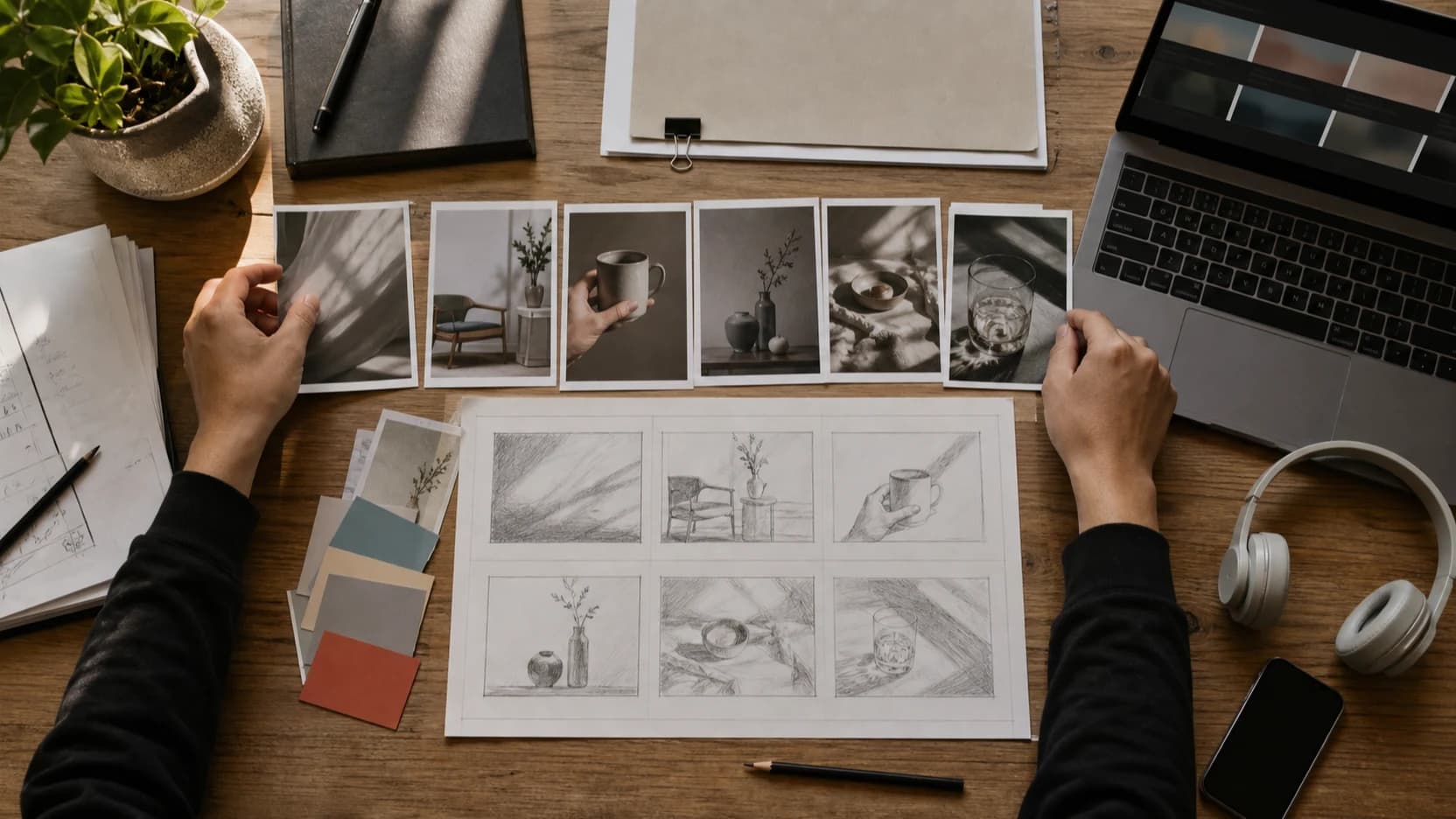
Reference files are not decoration. Each one should answer a specific question the model would otherwise have to guess.
A product image can establish proportions and approved colors. An environment image can establish location and light. Video can define movement; audio can define voice or ambience. Trouble starts when teams upload a folder instead of making choices.
Several product images may disagree about color, while mood videos may suggest incompatible camera styles. A clip intended for motion can also introduce a person or room the marketer never wanted.
Before uploading, label each asset in plain language:
- “Use this image only for the bottle shape and label colors.”
- “Use this clip only for the camera's circular movement.”
- “Use this photo for the café layout and morning light, not for the people.”
- “Use this audio for room ambience; do not add its music.”
The point is not to reach the maximum number of inputs. It is to reduce uncertainty without introducing contradictions. Three references with clear roles can be more useful than thirty references that all vote on the same decision.
For a broader view of the available creative routes, the ClipDance creative platform groups several video workflows in one browser-based workspace. ClipDance is an independent third-party platform and is not operated by or affiliated with ByteDance, so teams should verify the live controls and terms that apply to their chosen workflow.
Write a Shot, Not a Wish
Once the concept and references are settled, the prompt becomes much simpler. It should read like a compact note from a director to a crew: where the camera is, what happens, when the important beat occurs, what the sound contributes, and what must remain consistent.
Consider a product reveal for a plain ceramic travel cup:
Vertical medium close-up at counter height, with a slow push forward. One barista places a matte ceramic travel cup beneath an espresso machine in a warm morning café. From 0–4 seconds, the empty cup enters the frame. From 4–9 seconds, espresso pours while steam catches the window light. From 9–12 seconds, the barista closes the lid and turns the cup toward the camera. Hold the final composition for one second. Use café room tone, the espresso machine, and a soft click from the lid; no music or dialogue. Keep one cup, one pair of hands, and the same light direction throughout. No captions, extra products, jump cuts, or camera changes.
Words such as “cinematic,” “premium,” and “stunning” may describe an ambition, but they do not resolve production choices. Which direction does the light come from? Does the camera move? When does the product become readable? What remains on screen at the end? Concrete answers improve the shot more than another row of visual adjectives.
Generate the Risk, Not the Easy Part
The smartest first generation is rarely the full video. It is the moment most likely to fail.
If the concept depends on a hand picking up a product, test that interaction. If the same face has to survive a turn and a lighting change, test the turn. If spoken dialogue carries the message, test the line before building the scene around it. A polished establishing shot proves very little when the campaign depends on something harder ten seconds later.
Short tests also make revision more disciplined. Change one meaningful variable at a time. If the package drifts, improve the product reference or tighten the continuity instruction. If the action feels hurried, remove a beat or give it more time. If the opening lacks context, change the starting composition rather than burying the model in explanation.
Keep the prompt, references, settings, output, and rejection reason together. That record turns experimentation into a repeatable process.
The Generation Is Footage, Not the Finished Ad
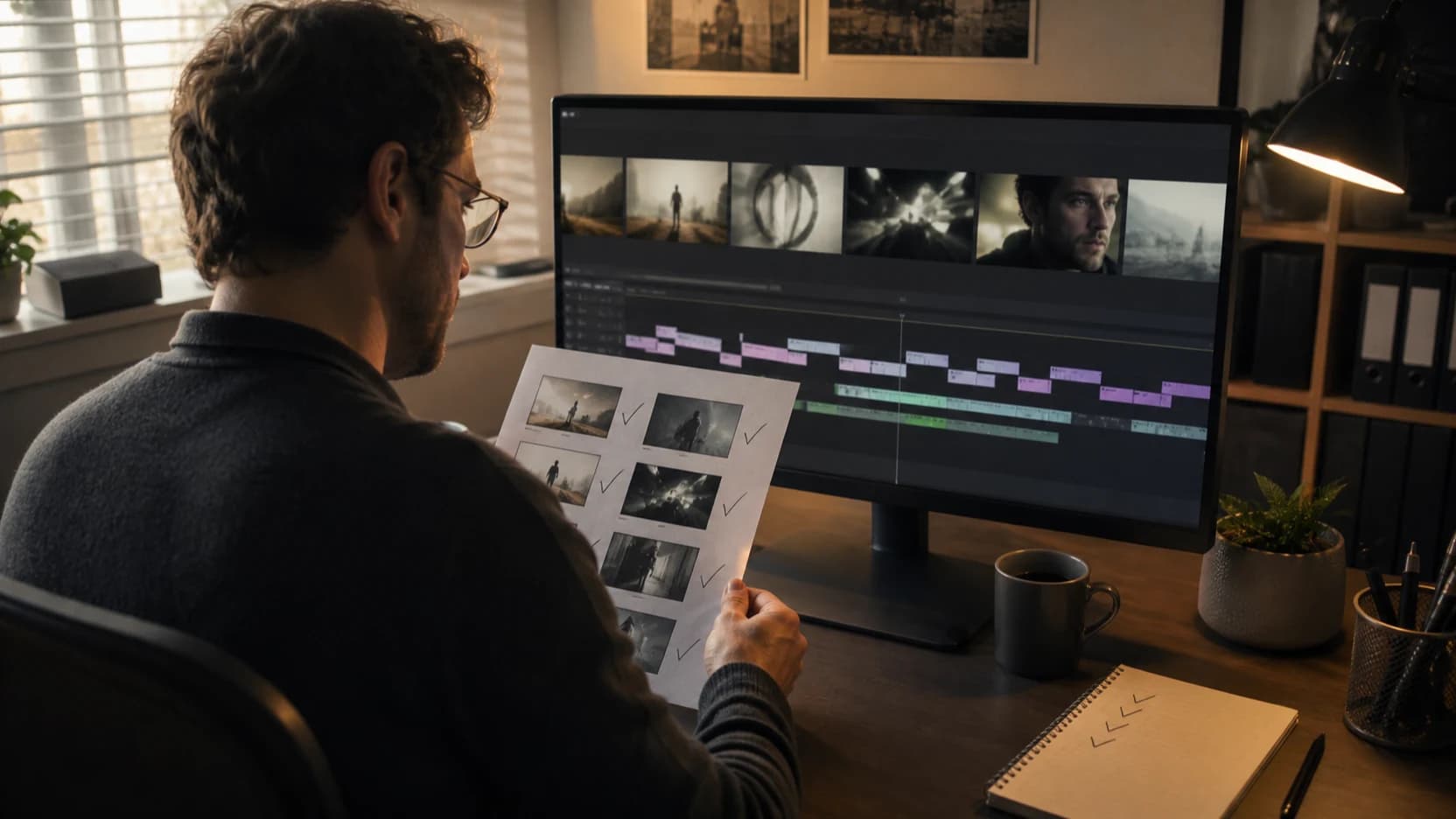
Watch the result three ways. First, watch normally and ask whether the story makes sense. Then mute it and see whether the action remains clear. Finally, slow down and inspect details: hands, faces, product shape, label geometry, reflections, shadows, background objects, and transitions.
The marketing review matters just as much. Does the product retain approved colors and proportions? Does the final frame give the viewer enough time to understand the call to action? Are captions necessary? Is the dialogue intelligible? Does the video make a claim that the landing page can support?
Rights and consent belong in this review. Teams should not use a person's likeness or voice, a protected character, a logo, music, or copyrighted source material without the appropriate permission. Generated imagery should not be presented as documentary evidence in sensitive contexts. A human approval step is not friction around the creative process; it is part of the process.
Trimming a pause, replacing audio, adding captions, or adjusting the ending may produce a better asset than another full generation. AI video changes the raw material entering post-production; it does not eliminate it.
One Idea Still Needs Different Channel Versions
A horizontal master is not automatically a vertical social ad. Cropping can hide a face under platform controls or remove the object that explains the action.
Once the idea is approved, recompose it for each channel. Protect the subject inside safe areas, check the first frame as a silent thumbnail, and keep the title, caption, video, and landing page on the same promise.
Measurement should return to the original job. Completion rate may reveal a pacing problem. Click-through rate can help evaluate the offer and call to action. Qualified conversions show whether the video attracted the right people, not merely more people. A beautiful clip with weak downstream behavior is useful information, but it is not a creative victory.
Seedance 2.5 Is a Production Option, Not the Strategy
Seedance 2.5 can be useful for campaign concepts, product-neutral b-roll, previsualization, short social scenes, and visual ideas that would be expensive to shoot before approval. Its longer continuous generation window is especially relevant when the action needs time to unfold without several stitched clips.
It is a weaker fit when every frame must reproduce regulated packaging, technical behavior, or a real person's performance exactly. Traditional filming, 3D rendering, licensed stock, or motion design may provide more dependable control. The right method follows the consequence of getting the detail wrong.
Marketers who want to assess the current interface can review the Seedance 2.5 video workflow on ClipDance. A sensible pilot uses rights-cleared, non-sensitive material and one small concept. The test is not whether the model can make something striking. The test is whether the team can turn its output into something accurate, approvable, and useful.
Frequently Asked Questions
Can Seedance 2.5 make a complete 30-second marketing video?
The current ClipDance workflow can generate a continuous shot up to 30 seconds. A complete marketing asset may still need editing, captions, brand graphics, disclosures, audio work, and channel-specific exports.
How many reference files should a marketer use?
Use the fewest files needed to settle important decisions. Every reference should have one stated role. Adding more files can introduce conflicting subjects, lighting, movement, or style.
Should AI-generated marketing video be disclosed?
Disclosure needs depend on the context, platform, market, and nature of the content. Teams should check current policies and seek appropriate legal guidance, particularly when realistic people, endorsements, sensitive subjects, or regulated claims are involved.
What is the best first test?
Generate the hardest moment on which the concept depends: a product interaction, identity held through movement, a precise camera path, or a spoken line. That test exposes production risk faster than an easy beauty shot.
The Brief Still Does the Hardest Work
Seedance 2.5 reduces the distance between describing an idea and seeing it move. That is valuable, but it does not decide what the audience needs, which promise matters, or whether the finished video deserves to run.
The strongest Seedance 2.5 marketing videos begin with ordinary marketing discipline. Choose one viewer, one message, one piece of visible proof, and one next step. Then let the model help produce the scene—not invent the strategy.
Author

Categories
More Posts
MiniMax H3 Prompt Guide: Text, Frames, References, and Audio
Write better MiniMax H3 prompts with practical workflows for text-to-video, first and last frames, mixed references, dialogue, audio, and reference costs.

How to make an anime music video with AI, step by step
Learn how to make an anime music video with AI: lock a character's look with reference-to-video, then cut every scene to the beat with a beat-sync tool.
Runway Gen-4.5 Image to Video: Add Motion Without Losing the Shot
Animate one finished image with Runway Gen-4.5 while protecting subject identity, product geometry, composition, lighting, and camera intent.