
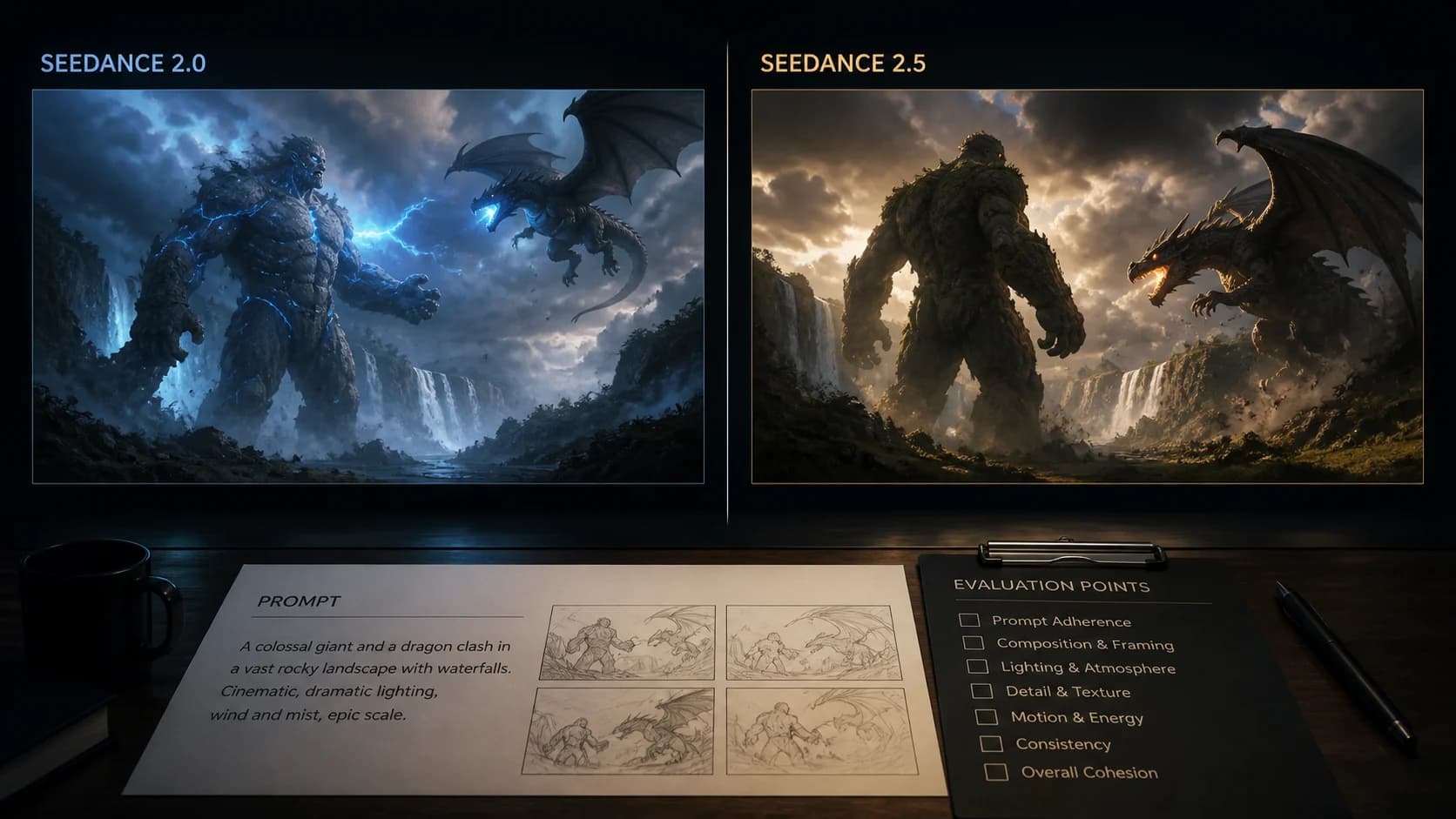
Seedance 2.0 vs Seedance 2.5: Three Same-Prompt Tests
A careful review of three public Seedance 2.0 vs 2.5 same-prompt tests, including their controls, missing variables, sponsorship context, and limits.
A Seedance 2.0 vs Seedance 2.5 comparison becomes more useful when both models receive the same prompt. It still does not become a controlled benchmark automatically.
This article examines three public comparisons posted on X. In each case, the creator says the prompt was held constant. One test also includes two generations per version, another presents a seven-shot sequence, and the third holds a final-frame reference constant. Those controls make the posts more informative than a mood-reel comparison assembled from unrelated clips. Important variables remain undocumented, though, including seeds, native export settings, rejected attempts, platform preprocessing, and whether every displayed clip was selected from the same number of runs.
These are not tests performed by ClipDance. We did not generate the clips, receive their native project files, or reproduce the creators' settings. The purpose here is narrower: to separate what the public evidence supports from what it cannot establish.
Short verdict
- The hedoist comparison is the strongest of the three because it publishes the prompt and reports two 10-second generations with each version.
- The Danioros comparison is useful for studying how models turn one prompt into a 15-second, seven-shot sequence, but it adds Wan 3.0 and comes from a Dreamina creator-program context.
- The Marco Riccetti comparison holds both the prompt and a final-frame reference constant, but it was made through Pollo AI and is labeled as a paid partnership.
- Together, the posts show that a matched brief can expose differences in interpretation, staging, and temporal organization. They do not establish average quality, failure rate, native resolution, cost per usable clip, or a universal winner.
What counts as a same-prompt test?
The phrase sounds stricter than it is. A prompt is only one input to a video generation. A controlled comparison also needs the same references, aspect ratio, duration, resolution tier, audio setting, negative prompt, enhancement options, and number of attempts. If seed control is available, its use must be recorded too.
The delivery path matters as well. A result generated in an official product can pass through different defaults from one generated by a third-party studio. Some services may rewrite prompts, add safety instructions, apply their own upscaling, or expose different model builds under similar labels. X then transcodes the uploaded video. A viewer is judging the published presentation, not necessarily either model's native file.
For that reason, this review uses three evidence levels:
| Public case | What the creator reports as controlled | Strongest evidence | Main missing controls |
|---|---|---|---|
| hedoist | Same published text prompt; two 10-second generations per version | Repeated text-to-video interpretation of a demanding action brief | Seed, settings, total attempts, native files, selection process |
| Danioros | Same prompt across Seedance 2.0, Seedance 2.5, and Wan 3.0 | Multi-shot prompt interpretation over a 15-second sequence | Exact settings, shot-generation method, total attempts, creator-program influence |
| Marco Riccetti | Same prompt and same final-frame reference | Reference-conditioned generation with a shared endpoint | Source-file access, wrapper behavior, settings, selection process, paid-partnership influence |
No row is a laboratory benchmark. Each one is still valuable if the claim stays within the variables actually shown.
Case 1: hedoist publishes the prompt and repeats each model
The clearest public evidence comes from hedoist (@hedo_ist), posted July 31, 2026. The creator says, “I generated two 10-second videos with each model,” and publishes one prompt for the Seedance 2.0 and Seedance 2.5 comparison.
The prompt opens with the short instruction, “A colossal giant appears, striding through a lake.” It then asks for a flying dragon to evade the giant's attempts to catch and stomp it, with water displacement, aerial movement, fast action, and realistic cinematography. In other words, it is not a beauty-shot prompt. It asks the model to maintain two differently scaled subjects, a relationship between their actions, an environment that reacts to force, and legible camera coverage.
Repetition is the important part. One output per version cannot tell us whether a striking difference is typical or lucky. Two generations remain a tiny sample, yet they offer a first glimpse of within-model variation. If both outputs repeatedly solve or miss the same beat, that is more informative than two isolated hero clips.
What this case can show
It can show how the displayed outputs interpret the same written action. A reviewer can ask concrete questions: Does the dragon remain distinct from the giant? Is a dodge readable as a reaction to an attempted capture? Does the lake respond to the giant's movement? Do the subjects recover their structure after a fast action? Does the camera help or obstruct the event?
The case can also show the range across two selected runs. Consistency matters almost as much as peak quality: a spectacular first run followed by a broken second suggests a different workflow from two less dramatic but editable results.
What it cannot show
The post does not disclose the seed policy, resolution setting, aspect ratio, audio controls, negative prompt, enhancement path, or complete generation history. “Two videos with each model” does not necessarily mean only two attempts were made. The creator may have selected four clips from a larger batch; the post does not settle that question.
Nor can an X upload prove native resolution or fine-detail superiority. Social compression, compilation layout, text overlays, and any edit before upload can change apparent sharpness. The sample is strong evidence of what these published runs contain, not a measurement of average Seedance 2.0 or 2.5 performance.
Case 2: Danioros tests a 15-second, seven-shot sequence
Danioros (@Dani__oros) published a comparison on August 4, 2026, placing Wan 3.0 beside Seedance 2.0 and Seedance 2.5. The creator states that all models used the same prompt and publishes that prompt in a reply. Each published result is presented as a 15-second sequence organized into seven visible shot beats.
That structure makes this a different test from hedoist's creature interaction. Seven shots in 15 seconds compress setup, visual changes, and payoff into a rapid sequence. Are the requested ideas present? Does the sequence move through them coherently? Are subjects recognizable after each cut? Does the final beat feel caused by what came before it?
More shots do not mean better performance. A model can produce seven attractive fragments while losing spatial or narrative continuity. Another can use fewer changes and communicate more clearly. Shot count describes the interpretation, not quality by itself.
What this case can show
The case can compare how three displayed outputs allocate the same brief across time. It is evidence about prompt-to-sequence interpretation: pacing, shot variety, subject persistence, and whether the requested payoff remains legible inside a short duration. Because Wan 3.0 appears alongside both Seedance versions, the post also gives useful context for whether differences are version-specific or common to several current video models.
What it cannot show
The post does not reveal whether the seven beats were produced in one native generation, assembled or altered afterward, or influenced by platform-specific defaults. It also does not publish a complete ledger of attempts and rejected results. Without the original files, we cannot compare codec, bitrate, native dimensions, or unedited audio.
There is a disclosure issue worth preserving. The post tags @dreamina_ai and uses #DreaminaCPP, while the creator's profile identifies a Dreamina CPP relationship. That does not make the footage false, and a creator program is not automatically a cash payment. It does mean the sample should be described as creator-program material rather than independent blind testing. The comparison is evidence to inspect, not an endorsement to repeat.
Case 3: Marco Riccetti adds a shared final-frame reference
The August 12, 2026 post from Marco “Shikoba” Riccetti (@shikoba_86) compares Seedance 2.0 and Seedance 2.5 through Pollo AI. The creator describes the runs as using the same prompt and the same visual constraint; the prompt reply identifies a common final-frame reference.
That extra reference changes the question. A pure text-to-video test asks each model to invent nearly everything. A final-frame test gives both versions a shared target and asks how they reach it. Reviewers can examine whether the path feels motivated, whether important geometry survives the movement, whether the ending converges on the supplied composition, and whether the transition becomes abrupt near the deadline.
What this case can show
It can show differences between the two displayed reference-conditioned results under a more specific common brief. If one output reaches the final frame while maintaining identity and spatial logic, and another treats the endpoint as a late visual snap, that is a meaningful observation about these runs. This is closer to a real production task than an unconstrained “make something cinematic” prompt.
What it cannot show
The outputs were generated through Pollo AI, so the comparison cannot isolate the underlying ByteDance model from the wrapper. We do not know whether prompt expansion, reference preprocessing, default enhancement, or separate model settings were applied. The public post also does not provide the source reference file, native exports, attempt counts, or seeds needed for reproduction.
Most importantly, X labels the post as a paid partnership. Sponsorship does not invalidate the visual record, but it changes how strongly we should trust the creator's framing. The footage may demonstrate a capability; it cannot serve as neutral proof that one paid platform, or one model version, is categorically superior. Any article using this case should keep the disclosure adjacent to the claim rather than hiding it in a source list.
What the three cases say when read together
The strongest conclusion is methodological: matching the prompt improves comparison, but the remaining controls limit the conclusion.
Hedoist offers the best evidence about repeated response to one complex text brief. Danioros adds a dense multi-shot problem and a third model, but also adds uncertainty about sequence construction and creator-program context. Riccetti controls a visual endpoint, which makes the reference task more specific, while third-party processing and paid-partnership context make broad ranking claims less defensible.
The cases support statements such as these:
- Seedance 2.0 and 2.5 can produce visibly different staging from the same public brief.
- Repeated generations help reveal within-model variation that one selected run cannot show.
- A reference-controlled comparison tests a different capability from text-only generation.
- Dense multi-shot output must be judged for continuity and prompt coverage, not shot count alone.
They do not support claims that one version always has better physics, sharper native output, stronger audio, lower cost, or a higher success rate. None of the creators publishes enough runs to estimate a distribution. None supplies untouched native exports and a complete settings manifest. Two cases also carry commercial or creator-program context.
This distinction matters because public comparison videos are often edited to answer “Which one looks cooler?” A production decision asks harder questions: How many attempts did it take? Which failure recurs? Can the accepted clip survive client revisions? What was the total cost per approved shot?
Why the existing fighting test is not equivalent
Our earlier Seedance 2.0 vs Seedance 2.5 fighting test examines a useful action comparison, but it does not belong in this same-prompt evidence set. Its two halves differ in framing, choreography, shot density, and editing. The 2.0 side often presents clearer key poses, while the 2.5 side attempts denser continuous interaction. That article is about motion clarity and the danger of confusing a harder shot with a worse model.
The three cases reviewed here answer a different question: what changes when creators report holding the prompt constant? They reduce one major source of variation, though they do not remove the others. Reading both kinds of comparison is useful as long as their evidence is not blended into one model ranking.
A reproducible Seedance 2.0 vs 2.5 test protocol
Creators making a real purchasing or production decision should go further than any of these posts:
- Use one access path. Run both versions through the same official product or provider whenever possible, and record the exact model IDs and date.
- Freeze every input. Save the prompt, negative prompt, reference files, first or final frame, aspect ratio, duration, resolution tier, audio option, and enhancement settings.
- Hash reference files. A filename is not enough. A checksum proves that both conditions received the same bytes.
- Use equal attempt counts. Generate at least four candidates per version for a small test. Keep failures and do not stop early when one side produces a favorite.
- Keep native exports. Review them before adding captions, interpolation, upscaling, color grading, or a comparison layout.
- Blind the labels. Ask reviewers to score prompt coverage, temporal identity, physical interaction, camera coherence, endpoint accuracy, audio sync, and editability without seeing the model name.
- Report spread and cost. Publish median scores, rejected-run reasons, generation time, and cost per accepted clip—not only the best frame.
For a final-frame workflow like Riccetti's, add a measurable endpoint score: composition match, subject scale, identity, background geometry, and how naturally the motion arrives. For an action brief like hedoist's, define the required causal beats before generating. For a seven-shot sequence, list the intended shots so reviewers can distinguish creative variation from omitted instructions.
Frequently asked questions
Do these same-prompt tests prove Seedance 2.5 is better than Seedance 2.0?
No. They show differences among selected public outputs under partially matched conditions. Missing settings, small samples, unknown selection processes, platform wrappers, and social-media compression prevent a general ranking.
Is hedoist's test a fair benchmark because each version has two runs?
It is fairer than a one-run comparison, not a benchmark. Two runs reveal some variation, but they are too few to estimate average reliability, and the post does not disclose whether additional runs were rejected.
Does using the same prompt guarantee the same task?
Only partly. The models may receive different hidden defaults or interpret the text differently. References, duration, aspect ratio, audio, seed policy, enhancement, and provider preprocessing also define the task.
Can sponsored X examples still be used as evidence?
Yes, with narrow claims and visible disclosure. A sponsored clip can prove that a displayed result exists. It cannot independently prove typical performance, neutrality, or superiority over alternatives.
The useful takeaway
These three public posts move the Seedance 2.0 vs 2.5 discussion in the right direction. Hedoist supplies a published prompt and repeated 10-second runs. Danioros tests rapid multi-shot interpretation. Riccetti adds a common visual endpoint. Each closes one gap left by casual comparison reels.
None closes all of them. Treat the clips as well-documented case studies, not universal verdicts. If a model choice affects a campaign, client deadline, or API budget, recreate the relevant task with equal run counts and native files. The best public sample tells you what was possible once; a controlled internal test tells you what your workflow can reproduce.
Sources
- hedoist (@hedo_ist), Seedance 2.0 and 2.5 comparison with public prompt and two runs per model, July 31, 2026.
- Danioros (@Dani__oros), Wan 3.0 vs Seedance 2.0 vs Seedance 2.5 same-prompt comparison and the disclosed prompt, August 4, 2026.
- Marco “Shikoba” Riccetti (@shikoba_86), Seedance 2.0 vs 2.5 same-prompt reference comparison on Pollo AI and the disclosed prompt, August 12, 2026.
Author

Categories
More Posts

Seedance 2.0 vs Sora 2: Which AI Video Generator Should You Pick in 2026?
A direct comparison of Seedance 2.0 and Sora 2 covering video quality, reference input, audio generation, pricing, and real workflows. Honest take from the Seedance team.
Best Seedance 2.5 Alternatives by Video Workflow
Choose a Seedance 2.5 alternative by workflow: MiniMax H3, Seedance 2.0, Veo 3.1, Sora 2, Runway Gen-4.5, or Kling 3 for the job you have now.

Sora 2 Video Generator Guide: Base vs Pro, Text vs Image, and Real Costs
Choose Sora 2 Base or Pro, text-to-video or image-to-video, with current ClipDance controls, credit costs, a sourced creator example, and API shutdown context.